


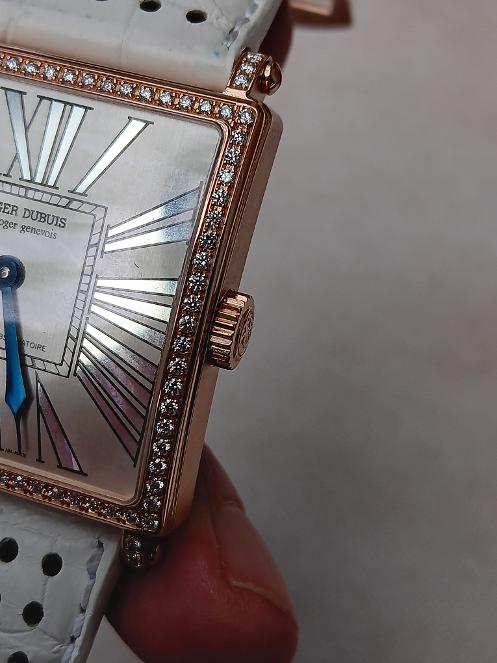



Offered here is an 18K rose gold Roger Dubuis Golden Square watch. The reference number G 40 57 5 and BTE 210315 are both engraved inside the case back. The slightly curved case measures 40 mm across. The bezel of this case is set with 80 brilliant cut diamonds and there are an additional 12 diamonds set in the lugs. The total diamond weight in the case is estimated at approx. 0.60 carats. The diamonds are high quality, factory set. VS or better clarity and G or better color. The dial is to die for!!! It is a gilt galvanic dial where all the Roman numerals are actually highly reflective metal.
These dials require much more work than regular painted dials.
The top sapphire crystal is curved and does not protrude from the bezel.
The exhibition back allows to view the cal. 57 25 jewels automatic movement.
This is officially certified chronometer movement.
Certification by French Bulletin D’Observatoire.
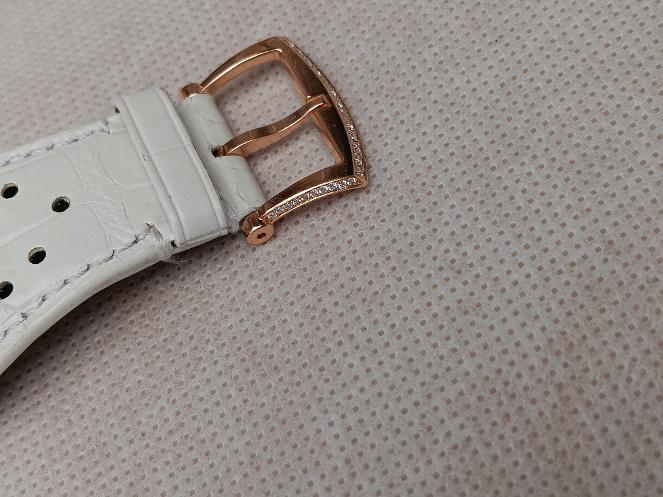
The watch comes with a Roger Dubuis white hand sawn leather strap and an 18K rose gold, diamonds set buckle.
The watch will fit up to a 7 inch wrist as pictured.
It is possible to add a couple more holes in the band or you can purchase another one to fit you.
This watch as other Roger Dubuis creations was issued in a limited edition of 28 examples and this one being number 7/28.
As pictured here the watch weighs 118.1 grams.
Lots of gold here!!
When first issued around 2002 this model carried a retail price of over $30,000.
This was when the price of gold was 1/10th of what it is today!
Priced here at $18,000.
The Movement: It is powered by the “”Caliber RD57, an in-house automatic winding movement featuring 25 jewels. It is certified with the prestigious “”Geneva Seal (“”Poinçon de Genève) and officially chronometer-tested.
On an early, master-era Roger Dubuis watch like the Golden Square, “”“BTE” stands for “”Bulletin d’Observatoire (Observatory Bulletin), and the numbers following it represent the watch’s “”official chronometer certificate serial number.
Before Roger Dubuis was acquired by the Richemont Group, the founder, Mr. Roger Dubuis himself, had a fierce dedication to old-world watchmaking standards. Every single watch he produced had to pass two strict tests.
The “”Geneva Seal (“”Poinçon de Genève) for finishing and decorative mastery.
A rigorous independent accuracy test performed by the “”Besançon Observatory in France.
When a movement passed the observatory’s multi-week accuracy trials, it was issued a “”Bulletin d’Observatoire (Certificate of Observatory Performance). Roger Dubuis proudly engraved “”BTE directly onto the gold casebacks of these limited series to signify that the movement inside was a certified elite chronometer.
G40 57 5 (signifying a smooth bezel rose gold variant) but features a flawless, layout-perfect execution of 92 factory diamonds (80 on the bezel, 12 on the lugs). In the early era of the brand, VIP collectors could order special case upgrades directly from the Geneva manufacture. Instead of re-stamping a new reference code on the case back, the manufacture tracked the upgrade internally via your unique “”BTE Chronometer Bulletin number.